Open Creator Rails: Monetization from Subscriber #1
OCR allows creators to run gated content directly on their own landing pages, sidestepping monetization thresholds entirely.

Let’s talk about the creator economy.
For over a decade, the web2 creator economy has been built on a fundamental flaw: platforms, not audiences, decide when creators are allowed to earn money. Today, we are excited to introduce Open Creator Rails (OCR), an open-source blockchain paywall and subscription stack built under contract for the Ethereum Foundation.
OCR renders platform permission structurally irrelevant. It allows creators to run gated content directly on their own landing pages, completely sidestepping the arbitrary monetization thresholds that keep the vast majority of creators working for free. For the burgeoning creator of any kind of digital content, OCR offers a true alternative to the algorithmic game that defines today’s content landscape.
The pre-monetization creator trap
Ask anyone, their answer to "what's wrong with the creator economy?" is usually "creators don't get paid fairly." This assumes, however, that the creators in question are already experiencing some success and are being paid at all. The real problem is earlier and more brutal: millions of creators below platform thresholds earn exactly zero. And they accept it because they have no alternative.
This is an industry-wide symptom:
YouTube
Full ad revenue sharing requires 1,000 subscribers and 4,000 public watch hours over 12 months (or 10M Shorts views). An early tier at 500 subscribers unlocks fan funding, but ad revenue remains strictly gated. (Source)
TikTok
The Creator Rewards Program demands 10,000 followers and 100,000 authentic video views in the last 30 days. Below that, LIVE gifts require 1,000 followers—and TikTok takes a 50% cut on virtual gift conversions. (Source)
Twitch
Streamers must earn Affiliate status (50 followers, 8 stream hours, 7 unique days, and 3 average concurrent viewers) before receiving a single cent in subscription or ad split revenue. (Source)
Spotify
Tracks must generate at least 1,000 streams per year to enter the royalty pool. Anything below 1,000 streams pays exactly $0. (Source)
Meta
In-stream video ads require at least 5,000 followers and 60,000 total minute views within a 60-day window. (Source)
These thresholds exist precisely to maximize the size of that unpaid labour pool while keeping the payout ceiling feeling attainable enough that people keep producing.
How Open Creator Rails solves this
OCR doesn't try to fix YouTube. It simply makes YouTube's permission structurally irrelevant.
The moment a creator can receive value directly from their first engaged viewer, the platform's gate loses its bite while its audience and reach remain in play.
Here is what OCR does under the hood:
- Onchain access control: OCR utilizes smart contracts to verify subscriptions or access rights directly at the paywall layer. The protocol dictates access, not a centralized middleman.
- Self-hosted control: The entire stack can be deployed directly on a creator’s custom landing page or web property.
- Direct value flow: Instant wallet-to-creator transactions. No more waiting for minimum payout thresholds or arbitrary 30-day settlement schedules.
Proof of concept: The OCR Pet Shop
To show how seamlessly this works, we've built a live, open-source demonstration using a Farm/Pet Shop interface.
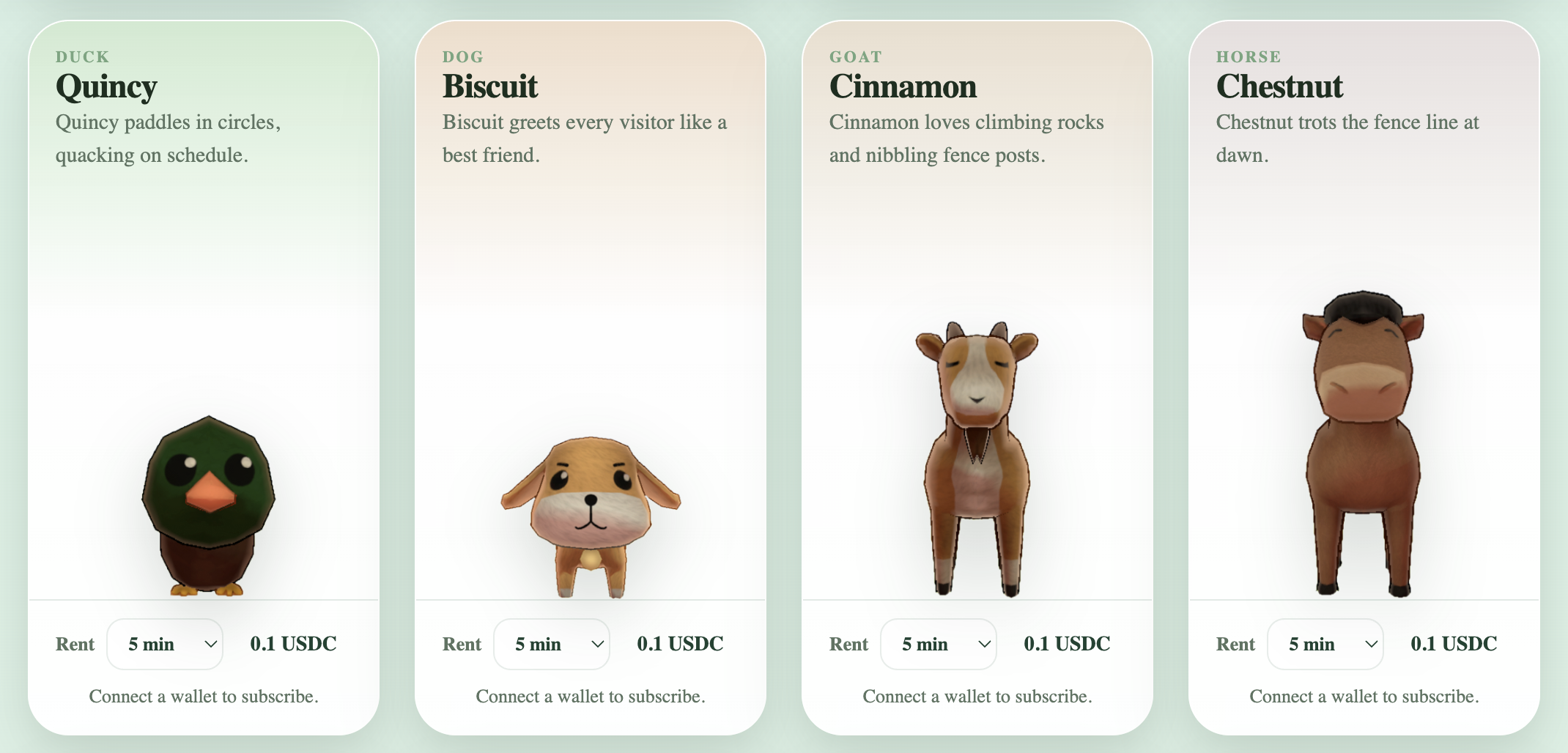
In the demo, users are presented with a straightforward web app that contains locked content (in this case, premium farm-animal cards and data). The demo presents a market state and a game state: animals rented via the onchain "Rent" button appear merrily in the pen in the game state.
- The gated experience: Specific media remains locked behind a lightweight, intuitive paywall.
- The transaction: A user simply connects their wallet and pays the subscription fee directly onchain. There are no platform accounts to create, no credit card forms to fill out, and no geographical restrictions.
- Instant access: Once the transaction is verified on the blockchain, the content unlocks instantly.
For developers: The underlying codebase in the open-creator-rails demo repo serves as a simple blueprint. You can grab these rails and plug gated paywalls directly into any frontend framework.
What Open Creator Rails enables
By removing the centralized gatekeeper, OCR unlocks a new set of practical applications for creators and developers alike.
Solo creator landing pages
You can now gate premium posts, video drops, code repos, or downloadable media directly on your own website. OCR unlocks fractional micro-subscriptions, meaning an audience member could pay $1 to read a single article or unlock an exclusive feed without committing to a monthly Patreon-style tier.
Niche & long-tail audiences
When you control the economics, 50 dedicated supporters paying you directly on a self-hosted OCR page is vastly more lucrative than 500 platform followers locked behind a payout wall you haven't reached yet.
Developer flexibility & ecosystem growth
Developers can adapt the OCR stack to build native web3 paywalls into existing CMS platforms, newsletters, or independent media sites. Because it's open-source, developers can poke, prod, and twist the architecture into shapes both unexpected and pleasant.
Getting started with OCR
We need to move the definition of a "monetized creator" away from algorithmic reach and back to audience connection. No platform should decide when you're ready to earn.
We want to know about your creations!
If you decide to implement OCR in your own landing page, reach out to us!
We want to know about your creations and how you monetize them with Open Creator Rails. If you’re keen to share what you’re earning with this tool, please reach out to us for a chat :)
About ChainSafe
ChainSafe is a leading blockchain research and development firm specializing in protocol engineering, infrastructure development & operations, and co-development.
Alongside its contributions to major ecosystems such as Ethereum, Polkadot, Filecoin, and more, ChainSafe creates solutions for developers and teams across web3.
As part of its mission to build accessible and improved tooling for developers, ChainSafe embodies an open source and community-guided ethos to advance the future of the internet.